
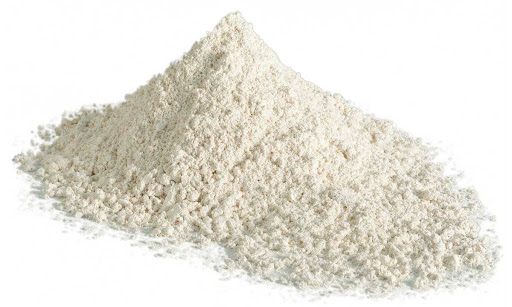
Engineers working with zirconia powder face a persistent tradeoff. Precipitated zirconia offers high purity and sinterability, but comes with agglomerated particles and high surface area that complicate dispersion and limit solids loading due to the high viscosity of suspensions. Fused zirconia provides durability but delivers angular particles with high aspect ratios, requiring intensive milling and expensive processing while still limiting solids loading. Both paths create downstream challenges that inflate costs and constrain what’s possible in formulation and processing.
A Grain monoclinic zirconia powder exists because Zircoa took a different manufacturing approach entirely. Rather than precipitation chemistry or fusion, Zircoa synthesizes A Grain from zircon sand using a proprietary solid-state reaction process. This process produces something neither conventional method can deliver: consistently distributed spheroidal particles with remarkably low surface area. The result is a powder with properties that solve problems instead of creating them.
We’re Your Zirconia Experts: Our specialists are here to help with material selection, custom solutions, and technical guidance for your specific applications.
The Spheroidal Advantage
Particle shape matters more than most spec sheets acknowledge. A Grain’s spheroidal particles aren’t just aesthetically different from the agglomerated structures of precipitated zirconia or the angular shards of fused material; they fundamentally change how the powder behaves in processing. Research across multiple industries demonstrates that particle morphology directly impacts material properties, including flowability, packing density, and dispersibility. These effects become especially pronounced at the micron scale, where A Grain operates.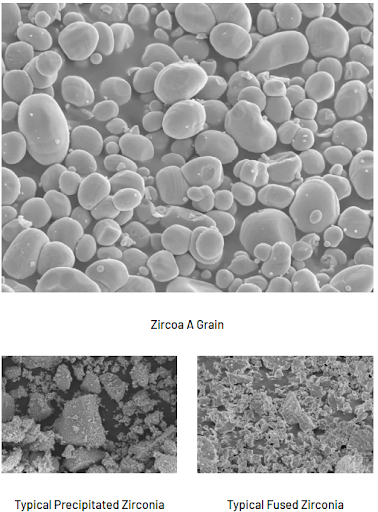
The spheroidal geometry enables exceptional dispersibility and flow. Where angular particles interlock and agglomerated powders resist breakdown, A Grain’s smooth spheres flow freely and distribute uniformly in various media. This translates directly to higher solids loading — 80-90% in typical spray drying applications compared to 50-70% for precipitated powders and 65-75% for fused alternatives. Higher solids loading means fewer processing steps, lower drying costs, and more throughput from existing equipment.
The surface area tells the other half of the story. A Grain’s 1 m²/g surface area sits dramatically below the high surface area typical of precipitated zirconia. A lower surface area means reduced reactivity during processing, lower binder demand in formulations, and superior flow characteristics that simplify handling. The 2 µm mean particle size provides consistency without requiring the intensive milling that fused zirconia demands.
Together, these properties create a material that simply processes better. Parts made with A Grain exhibit lower shrinkage during firing, improving dimensional control and reducing rejection rates. The powder disperses easily across different systems without specialized equipment or complex processing protocols. For manufacturers optimizing costs while maintaining quality, these aren’t minor conveniences but meaningful operational advantages.
Monoclinic Zirconia Powder Applications Where Properties Matter
A Grain’s unique characteristics make it the material of choice for applications where powder behavior directly impacts product performance or manufacturing economics.
Automotive oxygen sensors depend on zirconia’s ionic conductivity properties, but sensor manufacturers need powder that disperses uniformly and fires to precise dimensions. A Grain’s spheroidal particles and consistent particle size distribution enable the tight tolerances these sensors require. Similarly, zirconium metal production for automotive airbag initiators leverages A Grain’s high purity and processing characteristics to produce the reactive metal powders that enable critical safety systems.
Display glass manufacturers face a different challenge. They need a zirconia filler that toughens glass without introducing processing complications or contamination. A Grain’s low surface area and superior dispersibility allow uniform distribution throughout glass melts, while the spheroidal shape reduces abrasive wear on processing equipment. The result is tougher, more durable display glass produced more efficiently.
The chlor-alkali industry represents another domain where A Grain solves a specific materials problem. As manufacturers transition away from asbestos-based materials, they need alternatives that provide similar performance without health and safety risks. A Grain’s chemical inertness, thermal stability, and processing characteristics make it an effective non-asbestos material for chlor-alkali processes, supporting both performance and safety objectives.
Electronic ceramics manufacturing, catalyst support production, ceramic colorants, and refractory feedstock applications all leverage different aspects of A Grain’s property set. Some applications prioritize the high solids loading for processing efficiency. Others value dimensional stability or the consistent particle characteristics. The common thread is that A Grain’s distinctive properties enable either better products or better economics compared to conventional powder alternatives.
Beyond Standard Specifications
What makes A Grain genuinely one-of-a-kind isn’t just the current standard specification. It’s Zircoa’s ability to customize the powder’s chemical and physical properties for specific applications. The baseline 99.6% ZrO₂ purity with controlled trace elements represents a starting point, not a limitation.
Engineers working on novel applications or facing unique processing constraints can work with Zircoa’s materials team to modify properties while maintaining the core advantages of the spheroidal particle shape and solid-state synthesis approach. This customization capability matters particularly for R&D teams developing new products or manufacturers looking to optimize existing formulations. Rather than forcing an application to work around powder limitations, the powder itself can be engineered to support the application requirements.
Standard packaging in 500-pound (~ 226.8 kg) drums with plastic bag liners and typical lot sizes of 12,000 pounds (~ 5,443 kg) reflect Zircoa’s focus on commercial-scale manufacturing. This isn’t a laboratory curiosity or a specialty material produced in small batches. A Grain supports volume production across multiple industries, backed by quality control systems that ensure batch-to-batch consistency for critical applications.
Powder Selection as Process Optimization
Selecting zirconia powder shouldn’t require compromising between purity, particle characteristics, and processing economics. The limitations of precipitated and fused zirconia aren’t universal constraints; they’re artifacts of specific manufacturing approaches. When engineers understand that spheroidal monoclinic zirconia powder with low surface area exists as a third option, powder selection becomes about matching material properties to application requirements rather than working around inherent limitations.
A Grain represents Zircoa’s recognition that many applications benefit more from superior dispersibility and processing characteristics than from the specific advantages that precipitated or fused powders offer. For sensors, glass manufacturing, electronic ceramics, and dozens of other applications, the spheroidal advantage translates directly to better products or lower costs. That’s the value proposition of a truly one-of-a-kind manufacturing process.
Looking to optimize your zirconia powder processing or explore alternatives to precipitated and fused powders? Contact Zircoa’s materials specialists to discuss how A Grain’s unique spheroidal particles and low surface area can improve your specific application’s performance and economics.