
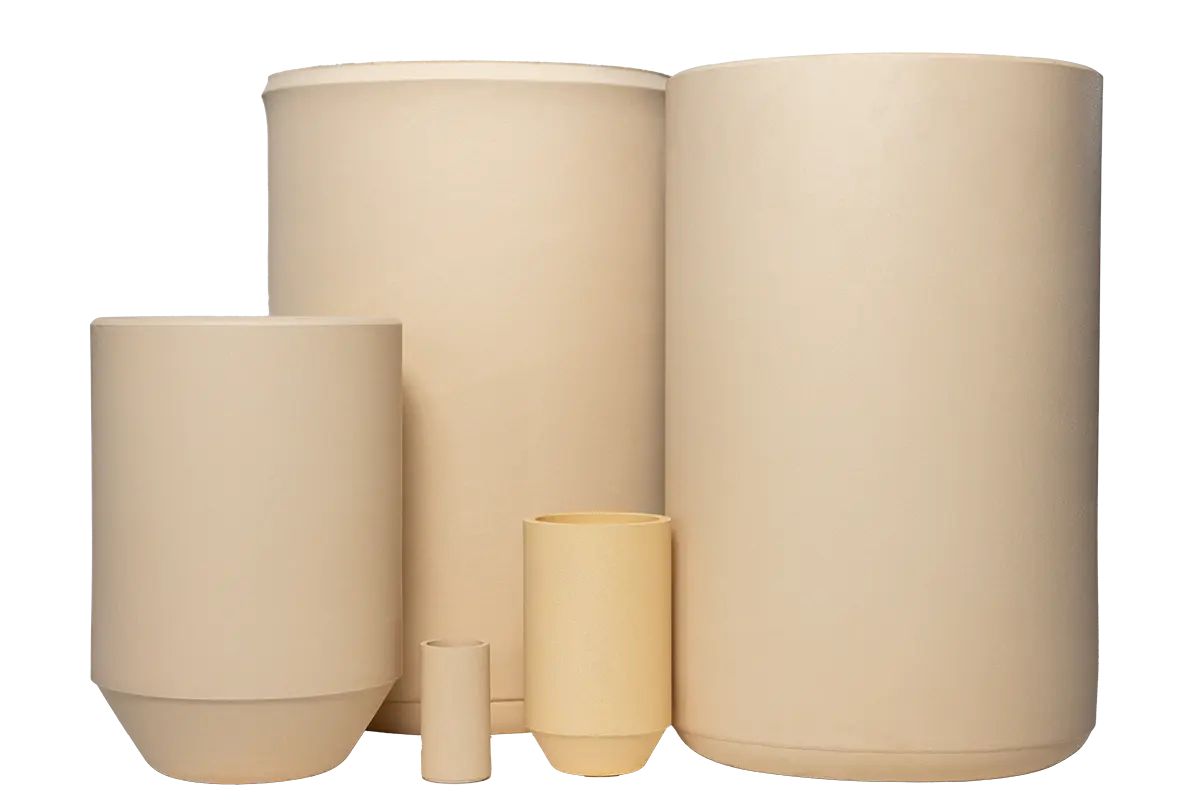
Zirconia Crucibles for Platinum Group Metal Processing
Melting platinum and its alloys isn’t a job for just any crucible. With melting points pushing past 2,000°C, and the added complexity of corrosive slags, aggressive thermal cycling, and the highest demands on melt purity, platinum group metal (PGM) processing demands ceramic materials engineered specifically for the task.
That’s exactly the challenge explored in Zircoa’s latest publication. Ronny Simon, Jake Mochoskay, and Tobias Schmidt recently co-authored a feature article for the American Ceramic Society Bulletin titled “Zirconia Crucibles: Enabling Reliable Melting of Platinum Group Metals.” The piece digs into why zirconia crucibles have become the go-to solution for PGM processing, and how composition selection makes all the difference.
The article breaks down four distinct zirconia crucible compositions Zircoa has developed, each engineered for specific operating conditions. From magnesia-stabilized zirconia handling continuous loads at 1,800°C and beyond to yttria-stabilized formulations capable of operating at 2,300°C for the most demanding platinum-rhodium alloys, the piece illustrates how Zircoa’s depth of materials engineering translates directly into application performance.
The authors also address one of the more nuanced challenges in zirconia crucible use: managing phase transitions. Zirconia passes through monoclinic, tetragonal, and cubic phases as temperatures change, and those transitions come with volume changes of approximately 3–5% that can cause cracking if thermal cycling isn’t designed carefully. The article includes thermal expansion data for each composition and specific temperature guidance — practical information that engineers can actually use.
PGM recycling adds another layer to the discussion. Since these metals are rare and expensive, the recycling process is economically critical—and it’s chemically punishing for crucibles. The ability of zirconia to resist glassy siliceous slags while maintaining surface smoothness that minimizes contamination makes it particularly well-suited for this work. The article also highlights Zircoa’s zirconia-based backup insulating materials, which provide approximately five times the insulating value of alumina or magnesia backups — extending crucible life and improving thermal efficiency in induction furnace installations.
Read the full article in the March 2026 issue of the American Ceramic Society Bulletin, or download the PDF directly from Zircoa’s website.
If you’re working through a similar challenge, whether in PGM processing or another high-temperature application, we’d like to hear about it.