
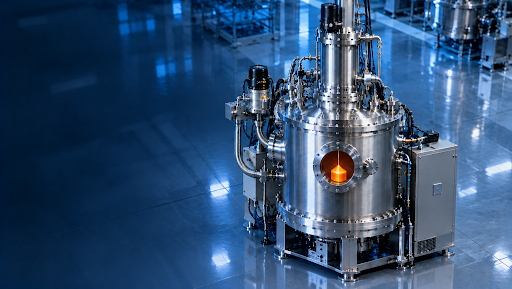
Why Crystal Quality Depends on the Furnace Around It
Inside an AI data center, the devices moving and conditioning light can feel far removed from the materials they came from. Behind many of those devices, however, is the same fundamental step: growing a large, high‑purity single crystal in a furnace.
Crystal growth furnaces convert raw materials into single crystals that become:
- Semiconductor substrates
- Laser host crystals
- Optical isolator components
- Precision optics and sensors
- Medical and industrial imaging elements
In each of these cases, the process needs more than just the right chemistry. It needs a furnace that can hold a tightly controlled thermal and chemical environment for as long as a growth run lasts. Refractories form the physical structure that makes that possible.
We’re Your Zirconia Experts: Our specialists are here to help with material selection, custom solutions, and technical guidance for your specific applications.
Crystal Growth Methods: Different Paths to a Single Crystal
Several industrial crystal growth methods are in common use. Each one manages temperature gradients, solidification, and crystal orientation differently, which in turn drives specific demands on the furnace and its refractory components.
Czochralski Method (CZ)
In the Czochralski method, a seed crystal is dipped into a molten charge in a crucible and slowly withdrawn while rotating. Material solidifies at the solid–liquid interface and adopts the seed’s crystallographic orientation, forming a cylindrical single crystal, or boule, over the course of the run.
Typical materials grown by CZ include:
- Silicon for semiconductor devices
- Sapphire for optics and LED substrates
- Laser host crystals such as YAG‑family materials
- Garnets such as GGG and SGGG for optical and magneto‑optic components
CZ furnaces for oxide and garnet systems can run at very high temperatures, with hot zones that can approach or exceed 2,000 °C depending on the material and atmosphere. In those conditions, hot-zone refractory linings must provide high temperature capability and insulation, low contamination and vapor release, and thermal shock resistance to cycling during startup and shutdown.
Bridgman and Vertical Gradient Freeze (VGF)
Bridgman and vertical gradient freeze methods solidify the melt directionally. Instead of pulling the crystal from the melt, the crucible moves through a controlled temperature gradient, or the gradient moves through a stationary crucible, so that solidification progresses along a specific direction.
These methods are used for:
- Compound semiconductors such as GaAs and InP
- Scintillator and detector crystals such as CdZnTe
Bridgman/VGF furnaces place strong demands on the stability of the hot zone. Refractory materials have to maintain their geometry so the imposed temperature gradient stays consistent, resist chemical attack from volatile species present during growth, and limit contamination that can create defects in the growing crystal.
Kyropoulos, EFG, and Related Methods
Other growth techniques, such as Kyropoulos and edge‑defined film‑fed growth (EFG), support specific crystal forms and sizes.
- Kyropoulos is widely used for large sapphire boules. It requires refractories that can remain stable and chemically compatible at high temperatures for extended campaigns.
- EFG and related methods draw ribbons or specialty shapes through a shaping die supplied by a thin liquid film. These processes are sensitive to interface stability and dimensional uniformity.
Crystals Enabling the Next Generation of AI Data Centers
AI data center infrastructure increasingly depends on the optical links replacing copper and photonics to move data at the required bandwidths and distances. Many of the critical components in those optical systems trace back to crystal growth furnaces.
Examples include laser crystals used in pump lasers and amplification stages, garnet‑based materials used in optical isolators and magneto‑optic devices, and sapphire and other oxide substrates for optoelectronic integration.
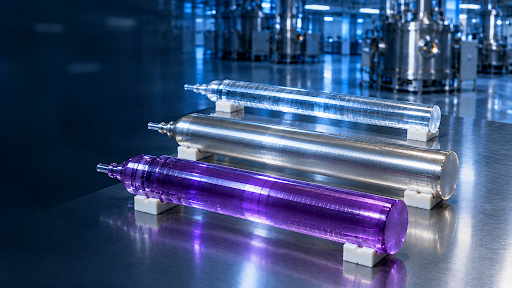
Whatever the method, the path from raw material to deployed component follows the same sequence. A crystal growth furnace is configured for the specific chemistry and temperature regime, a hot zone supported by refractories manages heat flow and protects the process, and the finished crystal moves on to cutting, polishing, coating, and device fabrication.
The scale‑up of AI data center capacity therefore depends, in part, on the ability to scale these crystal growth processes reliably and repeatably. That, in turn, depends on the refractories that shape and protect the furnace environment.
Crystal Growth Environments That Demand Zirconia Refractories
Not every crystal growth application runs at the same temperature or in the same atmosphere. Zirconia refractories are chosen where the combination of temperature, chemistry, and mechanical demands exceeds what conventional materials can handle.
Typical environments where zirconia plays a central role include:
High‑Temperature Oxide and Garnet Growth
- Hot zone temperatures that can reach or exceed 1,800–2,100 °C
- Oxide melts and vapor species that can degrade lower‑temperature refractories
- Strict purity requirements, where even small amounts of volatile species or particulate matter are unacceptable
In these regimes, zirconia refractories are used for:
- Tubes lining the hot zone for heat retention in the process zone
- Structural rings, plates, and supports near the crucible
- Granular material to enhance thermal insulation and efficiency
Sapphire and Other Oxide Crystal Growth
- Sapphire boules and ribbons grown at very high temperatures in oxidizing or inert atmospheres
- Other oxide laser and optical crystals grown in similar regimes
Zirconia offers:
- High refractoriness in typical oxidizing or inert atmospheres for oxide growth
- Low wetting and limited reaction with many oxide melts compared to alternative refractory options
- Mechanical strength and toughness for structural components
Selected Compound Semiconductor and Functional Oxide Processes
In some compound semiconductor and complex oxide growth processes, hot‑zone designs and atmospheres can be compatible with zirconia’s chemistry and thermal properties. Where that is the case, zirconia components provide:
- Structural support that remains dimensionally stable at temperature
- Low‑contamination surfaces in regions with severe gradients or radiant exposure
Across these environments, the compatibility of zirconia refractories must be evaluated case by case against the specific crystal system’s chemistry, atmosphere, and temperature. When the match is correct, zirconia enables growth conditions that many other refractories cannot sustain.
Why Zirconia Refractories Are Chosen for Advanced Crystal Growth Environments
Fundamental Materials Advantages
Ultra‑high temperature capability
- Zirconia refractories can operate up to and beyond 2,000 °C in many oxidizing and inert environments.
Thermal shock resistance
- Partially stabilized zirconia microstructures provide exceptional resistance to thermal shock.
- This helps components withstand multiple heat‑up and cool‑down cycles that are inherent to crystal growth campaigns.
Mechanical strength and toughness
- Zirconia is significantly tougher than many traditional oxide refractories.
- High fracture toughness and strength at elevated temperature are critical for tubes, supports, and cast shapes under mechanical load.
Chemical stability and low contamination
- Zirconia is relatively inert to many oxide melts and vapor species at high temperature.
- Low volatility and controlled impurity levels help minimize contamination of melts and growing crystals.
Dimensional and phase stability with proper stabilization
- Stabilizers, such as CaO in partially stabilized zirconia, are used to manage phase transformations.
Process and Economic Benefits for Crystal Growers
Improved crystal quality
- A cleaner hot‑zone environment and low particulate shedding reduce defects and inclusions.
- Stable hot‑zone geometry and temperature distribution promote uniform growth.
Higher yields and lower total cost of ownership
- Longer refractory service life means fewer hot‑zone rebuilds and unplanned failures, so more pulls per campaign succeed.
- While zirconia refractories are a premium material, that durability can reduce downtime, support higher throughput, and lower scrap rates in high‑value crystal production.
Design flexibility
- Cast shapes and tubes can be tailored to specific geometries, wall thicknesses, and support configurations.
- This allows furnace designers to optimize assembly, gas flow, radiant heat distribution, and mechanical support for their particular process.
Zircoa’s Zirconia Refractory Solutions for Crystal Growth
Zircoa supplies zirconia‑based refractory components for crystal growth furnaces where temperature, purity, and dimensional stability all have to hold at once.
Typical roles for Zircoa components that help define and maintain the thermal field around the crucible and melt include:
Tubes and backup materials for efficient hot-zone containment and thermal management
Custom cast shapes engineered for structural support and design flexibility
Talk to our team about your furnace. We can help you evaluate where zirconia refractories belong in your hot‑zone design, and how Zircoa components can support the performance and reliability targets your crystal growth process has to meet.