
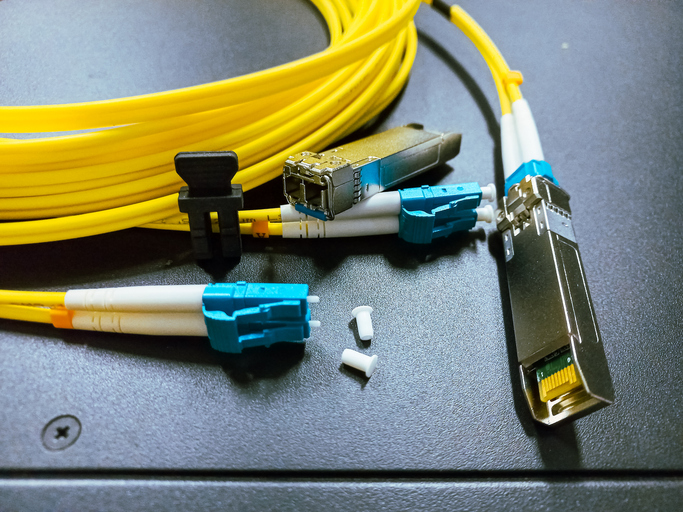
The Bottleneck Moved From Compute to Connection
AI infrastructure has a movement problem. The industry spent several years solving for compute density, and the constraint moved somewhere less visible: getting data between processors fast enough to keep them working. The copper-to-optical transition now underway across data centers is the response to that constraint. It reaches further down the supply chain than most coverage suggests. Behind every optical link is a crystal, and behind every crystal is a furnace.
We’re Your Zirconia Experts: Our specialists are here to help with material selection, custom solutions, and technical guidance for your specific applications.
Copper Ran Out of Room
Copper interconnects carry electrical signals well over short distances. As cluster sizes grew and the distances between racks stretched, the physics stopped cooperating. Signal integrity degrades with distance and frequency, power draw climbs to compensate, and the energy spent moving data becomes heat that then has to be removed.
Optical transmission sidesteps most of that. Light carries more data per channel, over longer distances, with less energy lost in transit. The copper-to-optical transition is arriving in stages. Rack to rack first, then module to module, and eventually closer to the processor itself. Industry analysts expect essentially all AI data center interconnects to be optical within five years.
The Economics Arrived Before the Infrastructure
The case for the copper-to-optical transition is no longer theoretical. Moving a 1.6 terabit link from pluggable transceivers to co-packaged optics can drop the power required from roughly 30 watts to 9 watts. At the scale of a modern AI facility, where thousands of links run continuously, that difference lands on the utility bill and in the cooling load at the same time.
Capital has followed. Optical transceiver revenue tied to AI applications is tracking from roughly $16.5 billion in 2025 to $26 billion in 2026, and NVIDIA alone has committed more than $6 billion across photonics component suppliers starting in March 2026. Manufacturing capacity is being built now, on the assumption that the demand is durable.
Light Does Not Ship Itself
Optical data transmission requires physical components at both ends of every link: lasers to generate the signal, fiber to carry it, and a set of optical elements that condition and direct it along the way. Several of those elements are single crystals.
Single crystals are not fabricated the way semiconductors are. They are grown, one at a time, from molten material inside highly controlled furnaces. Depending on the material system and growth method, a single growth cycle can take over a week and require operating temperature close to 2,000°C. What comes out is one continuous atomic structure, and that continuity is what gives the crystal the optical properties the application depends on. Any interruption in the structure is a defect, and defects become scrap.
Scaling optical component production therefore means scaling crystal production. Scaling crystal production means running more furnaces, for more hours, with fewer failed runs.
The Materials Layer Under the Supply Chain
Those ultra-high-temperature furnaces are lined with specialty refractory tubes, custom shapes, and insulating backup materials.
The lining has to hold both its shape and its insulating value at 2,000°C, a temperature where many refractory materials are already past their practical service limit. It has to survive a full thermal excursion from room temperature to peak and back on every cycle, then be disassembled, inspected, and returned to service. And it has to do all of that without contributing anything to the environment inside the furnace, because trace contamination from the lining shows up as a defect in the crystal.
This is the layer that rarely appears in coverage of AI infrastructure. Investment in domestic photonics capacity converts into actual output only if the materials feeding those furnaces are available at the same pace. Reshoring an optical component supply chain means reshoring everything underneath it, refractories included.
Zircoa is one of the few domestic suppliers capable of producing specialty refractories engineered to meet the temperatures, purity specifications, and dimensional stability this process requires.
Talk to our team if you are designing or scaling crystal growth furnaces or photonics production equipment. Our engineers can help specify zirconia refractories that balance temperature capability, purity, and service life.