
Specifying Wear-Resistant Zirconia Ceramics for Abrasion, Erosion, and Impact Service
Most wear parts do not fail dramatically. A pump sleeve loses a few thousandths, a valve seat washes out, a die bore opens up, and the process drifts out of specification before anyone pulls the component. By then you have scrapped product, an unplanned outage, and a maintenance interval you can no longer predict.
The usual response is to specify a harder material. Hardness is the easiest property to compare across a data sheet. It is also one of the weakest predictors of how long a component actually survives in service. Wear-resistant zirconia ceramics reach service life by a different route, and understanding that route is what makes them specifiable.
We’re Your Zirconia Experts: Our specialists help with material selection, custom solutions, and technical guidance for your specific applications.
Why Hardness Alone Does Not Predict Wear Life
Alumina and silicon carbide are both harder than zirconia. In clean, low-impact abrasion, they perform well. Introduce interrupted contact, edge loading, particle impingement, or thermal cycling and the failure mode changes. Hard oxide ceramics chip. Once an edge chips, the damaged surface accelerates its own wear, and the part is finished long before the bulk material has been consumed.
Zirconia ceramics resist that failure mode through transformation toughening. Under stress at a crack tip, the tetragonal phase converts to monoclinic with a volume expansion that puts the crack front into compression and arrests propagation. Published research on transformation-toughened zirconia has shown that impact resistance tracks directly with the material’s capacity to undergo that transformation. Zircoa engineers its magnesia-stabilized compositions around that mechanism, which is why a zirconia component stays in service in conditions that have already chipped out a harder ceramic.
Matching Zirconia Ceramics to the Wear Mechanism
Specifying a wear component starts with identifying which mechanism is consuming the part. Zirconia answers each one differently.
- Abrasion. Hard particles cutting a surface under load. This is the mechanism where hardness genuinely governs, and where zirconia substantially outperforms the hardened steels these components are usually made from.
- Erosion. Particle impingement in a flowing stream, common in slurry handling, nozzles, and valve trim. Energy arrives in discrete impacts, so fracture toughness governs survival more than hardness does.
- Adhesive wear and galling. Contact that tears and transfers material, particularly in dry or marginally lubricated service. Zirconia runs against metal with a low unlubricated sliding coefficient and is chemically inert, so it does not build the transfer layers that drive galling.
- Corrosion-assisted wear. Chemical attack that softens a surface so mechanical action removes it faster. Zirconia resists organic solvents, caustics, acids, and molten metals, eliminating the chemical half of the mechanism.
- Impact and edge loading. The condition where hard ceramics chip out. Transformation toughening is the direct answer here.
Replacing Metal Components Without Redesigning the Assembly
Substituting a ceramic for a metal part usually stalls on fit rather than on performance. A material that wears well but expands differently, or that behaves nothing like the housing around it, creates assembly and thermal cycling problems that cancel out the wear benefit.
Zircoa’s engineered compositions are unusual on both counts. Their elastic modulus is close to that of steel, and their thermal expansion behaves more like a metal alloy than a typical ceramic. That combination supports shrink-fit assembly and lets components cycle inside metal housings without the interference problems that complicate other ceramics. Zircoa components maintain strength to 1500°F (815°C), which covers the temperature envelope for most industrial wear services.
Composition Selection Is the Engineering Work
Wear-resistant zirconia ceramics are not one material. Zircoa formulates multiple compositions that trade properties against each other deliberately, balancing strength against thermal expansion and toughness against hardness. The composition that survives a high-impact valve application is not the one you want in a part that sees wide temperature swings.
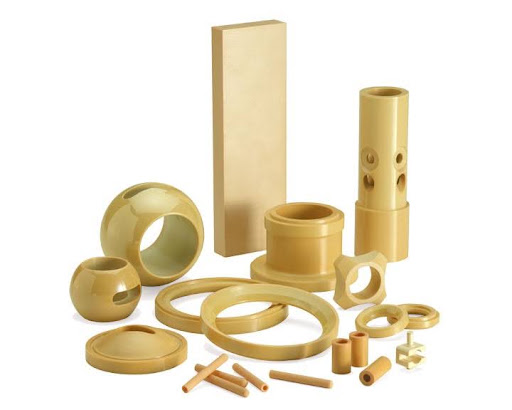
Choosing correctly requires knowing the wear mechanism, the counterface, the thermal profile, the process chemistry, and how the part is mounted. That is why most component inquiries begin as an engineering conversation rather than a part number. Zircoa’s team works through application assessment, material selection, CAD design, and precision machining to tolerance, producing engineered ceramic components including bushings, valve trim, pump components, sensors, and custom wear parts.
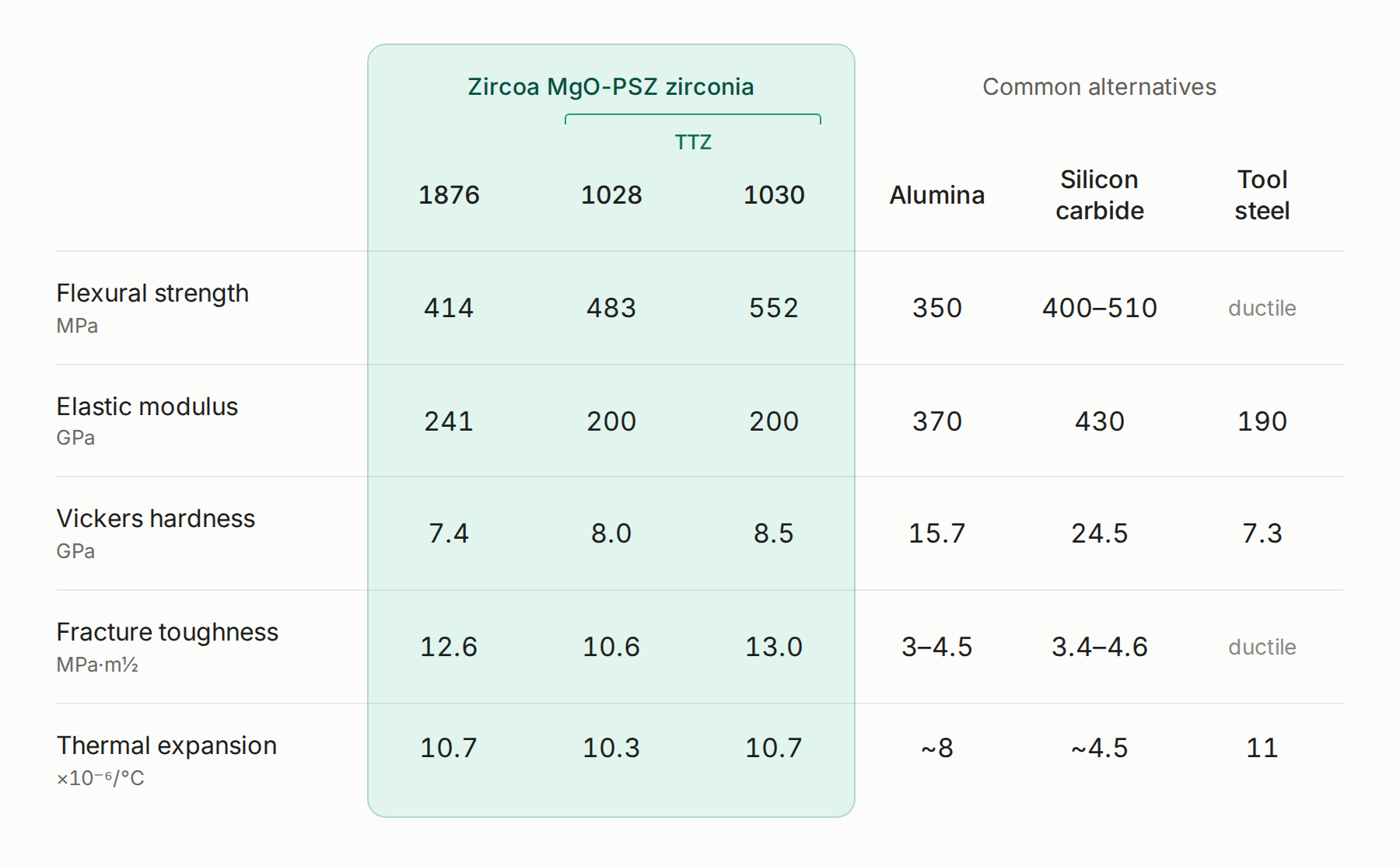
Typical properties of three Zircoa magnesia partially stabilized zirconia (MgO-PSZ) compositions compared with common wear materials. Compositions 1028 and 1030 are transformation-toughened zirconia (TTZ) grades.
Note: Tool steel is D2, hardened to 62 HRC. Alumina is 99.5% Al₂O₃. Silicon carbide is pressureless sintered. Zircoa values are from manufacturer data; comparison values are from published datasheets.
Zirconia wear components have a long production record. Zircoa’s ceramic die inserts, for example, have replaced tool steel and Stellite in copper tube extrusion — as documented here. The same material logic carries across pump, valve, and custom component applications.
Specify the Right Wear Component for Your Application
If a component in your process is wearing out faster than your maintenance interval allows, the useful next step is a conversation about the mechanism rather than a catalog search. Contact the Zircoa team to review your application and identify the composition and geometry that will hold up.