
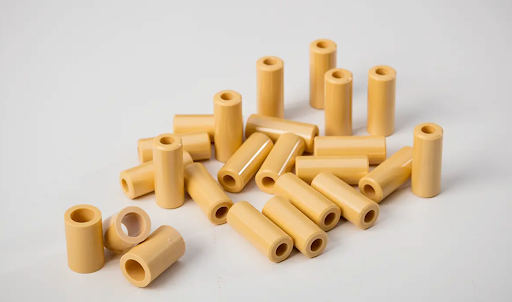
As Carbide Costs Rise, Zirconia Emerges as a Viable HVOF Coating Alternative
For decades, high velocity oxy-fuel (HVOF) tungsten carbide coatings have been a reliable engineering solution for components that face abrasive wear, erosion, and corrosion in demanding industrial environments. Applied at hypersonic velocity to metal substrates, these coatings deliver hardness and wear resistance on pump components, valve trim, nozzles, extrusion dies, and other high-contact parts.
That reliability has always come with a supply dependency. Tungsten carbide is sourced overwhelmingly from China, which controls more than 80% of global production. Export controls introduced in 2024 and expanded in early 2026 have tightened availability sharply, and the entire thermal spray ecosystem has felt it, with prices and lead times rising across the board. Tungsten carbide powder alone has seen a price increase of more than 200% since early 2024, with most analysts projecting sustained pressure through 2026 and into 2027. The pressure is not limited to coatings. Solid press-and-sintered carbide tooling draws on the same constrained supply at far greater material volume per part. Engineers who have built processes around HVOF carbide coatings and solid carbide tooling are now asking a straightforward question: what else can do the job?
For a defined range of high-wear, abrasive applications, engineered zirconia ceramic components are a serious answer.
We’re Your Zirconia Experts: Our specialists are here to help with material selection, custom solutions, and technical guidance for your specific applications.
What HVOF Carbide Coatings Do
HVOF accelerates coating powder through a combustion jet at extremely high velocity, depositing a dense, tightly bonded layer onto a metal substrate. The most common materials are tungsten carbide in a cobalt matrix (WC-Co) and chromium carbide in a nickel-chromium matrix (CrC-NiCr). The process excels when substrate geometry is fixed, wear is localized to the surface, and the application calls for a thin protective layer rather than full component replacement. That is a surface treatment strategy, and the distinction matters when evaluating zirconia as an alternative.
The Technical Case for Engineered Zirconia
Zirconia is not a coating. It is a bulk engineering ceramic. This means the component itself is manufactured from zirconium oxide (ZrO₂), engineered from powder to finished part. In the right application, this is an advantage, not a limitation. There is no coating-to-substrate bond to delaminate, no binder phase to corrode, and no surface layer to exhaust. The wear resistance runs through the entire component. Against solid carbide tooling, that comparison is direct rather than a substitution: two bulk materials, comparable manufacturing routes, the same finished geometry.
Zircoa’s engineered ceramic components deliver several properties directly relevant to wear applications where carbide has traditionally been specified:
Hardness exceeds chrome-plated steel at elevated temperatures. Zircoa’s compositions maintain hardness through operating conditions that cause metallic coatings and binders to soften or degrade.
Fracture resistance through transformation toughening. When subjected to fracture stress, zirconia undergoes a crystalline phase transformation in which the stressed zone expands, closing cracks before they propagate. This self-limiting mechanism — a K1C fracture toughness of up to 13 — gives zirconia better crack resistance than most ceramics and significantly better than hard chrome or comparable oxide ceramics.
Greater corrosion resistance than alumina or tungsten carbide. In environments where aggressive media attack the cobalt or nickel binder phase in carbide cermets, zirconia’s chemical inertness is a meaningful differentiator. It resists attack from organic solvents, molten metals, caustics, and acids.
Galling resistance in tool-to-workpiece contact. Galling is adhesive wear. Under load, metal-on-metal contact cold-welds at the asperities, transfers material, and tears the tool surface. Zirconia is an oxide ceramic with no metallic affinity for the workpiece, so the adhesion mechanism has nothing to initiate against. Combined with a low sliding coefficient of friction against metals, the result is less material pickup, cleaner surface finish on the part, and reduced wear on both the tool and the workpiece.
Engineerable properties. Zircoa’s compositions are tailored through stabilizer selection (magnesia, calcia, yttria), grain size, and forming method. The result is a material tuned for the specific operating environment — not a commodity product applied uniformly to every application.
Where the Substitution Works — and Where It Doesn’t
Zirconia performs well as a carbide alternative when abrasive or corrosive wear is the primary failure mode and impact loading is moderate. Applications involving continuous sliding wear, erosive particle contact, corrosive fluid exposure, or high-temperature environments where carbide binders degrade are strong candidates for evaluation.
The substitution requires more careful engineering consideration in applications dominated by severe impact, high bending loads, or sudden mechanical shock. Zirconia’s transformation toughening improves fracture resistance relative to other ceramics, but a direct comparison to carbide’s toughness in high-impact environments should be evaluated application by application. Zircoa’s application engineering team works through this with customers before any specification is made.
The other consideration is geometry. HVOF coatings apply a thin layer to an existing part. Switching to an engineered zirconia component typically means redesigning the part in ceramic — which requires an engineering conversation, not just a material swap. For many applications, that conversation is straightforward. For others, it requires more evaluation.
Solid Carbide Tooling Faces the Same Pressure, Multiplied
The supply pressure on HVOF powder is the visible version of a broader problem. Coatings consume carbide in microns. Solid press-and-sintered carbide tooling consumes it by the part.
For drawing dies, forming dies, punches, and wear components machined from solid WC-Co, the same price curve and the same lead time uncertainty apply against far greater material volume per unit. Tool manufacturers who absorbed coating cost increases are finding solid tooling much harder to absorb.
The technical comparison also gets simpler. Replacing a coating means rethinking a surface treatment strategy. Replacing a solid carbide tool with magnesia partially stabilized zirconia (MgO-PSZ) means substituting one press-and-sintered, finish-machined monolith for another. The manufacturing route is comparable, and the geometry is largely established.
Zircoa’s magnesia-stabilized extrusion dies are the proof of concept already in production. Composition 2016 displaces tool steel, Stellite, and high-strength nickel alloy dies in copper, brass, and copper-nickel extrusion, and is a direct candidate wherever carbide-based dies are currently specified.
Zircoa Products to Consider
Several Zircoa product categories are directly relevant for engineers evaluating carbide alternatives in abrasive and wear applications:
Engineered Ceramic Components — Custom-machined zirconia parts engineered for specific application requirements. Valve trim, pump components, wear parts, and ceramic bushings are all served from this category. Most inquiries involve new, custom developments; Zircoa’s engineering team develops parts from initial application assessment through production.
Ceramic Extrusion Dies — Magnesia-stabilized zirconia dies engineered for extruding non-ferrous alloys including copper, brass, and copper-nickel. Zircoa extrusion dies already outperform traditional tool steel and Stellite alternatives, and are a direct candidate for applications where carbide-based dies are currently specified.
Start with an Application Review
Zircoa approaches every carbide alternative inquiry as an engineering problem, not a catalog selection. The right composition, geometry, and product form depend on your specific wear environment, operating temperature, chemical exposure, and mechanical loading conditions.
If you’re evaluating alternatives to HVOF carbide coatings for a specific application, contact our specialists to discuss whether an engineered zirconia solution is the right fit.